2011年12月12日星期一

WS4 Fuel Pressure and flow

Fuel Pressure and flow

Warning, be careful around raw fuel. It can catch fire! Use appropriate safety precautions.
Keep sparks, flame, your body and your clothing away from raw fuel! Know where your fire

extinguishers are and use them if necessary.

Locate the two closest fire extinguishers. Write down where they are: 
The fire extinguishers one is in the front of the shop and the second one is on front of the next shop.

Attach fuel pressure gauge and notice which scale on the gauge you will be using. Briefly turn key on or start vehicle, then turn it off. Check for fuel leaks
I attach the fuel pressure gauge and then we  watched the scale on the gauge after that I turned on the car and check for any air leaks and that's no leak.

Measure the fuel pressure with the key on, engine off.
Record it here: 35psi 

Idling: Measure the fuel pressure with the engine idling. Watch the pressure for a couple of minutes 
Record pressure here: 38psi 

Maximum: With the engine idling, use the special tool to clamp the fuel return lin.
Note: this can only be done for a short period
Record pressure here: 48psi

WOT: With the engine idling, disconnect an plug the vacuum line going to the fuel pressure regulator
Record pressure here: 48psi  

Residual: Turn off the engine, and watch the fuel pressure for five minutes
Record your residual or rest pressure here: 43psi

When I've done those test then i had turn the key on and off, check for any leaks that might have happened during the test . I had to make sure the car was safe and runs fine. Its important to to keep the fuel being injected into the motor at the right amount too much pressure would engine run in rich and could have dripping injectors too little pressure would mean to engine would run lean and lacking in power.
When I have low fuel pressure I will have low engine performance engine running rough due to the lean mixture it might take longer to start the engine sometimes. also when we have low fuel flow the engine will be misfiring also low engine performance and engine will be rough as well due to lean mixture and fuel not being able to atomize well. But its different when we have high fuel pressure the engine will be running rich which mean higher fuel consumption could end up in dripping in injectors making the engine harder to start also will be using more gas or wasting it could end up costing you a lot of money on gas . 
  

Controlled Area Network Board

Controlled Area Network Board

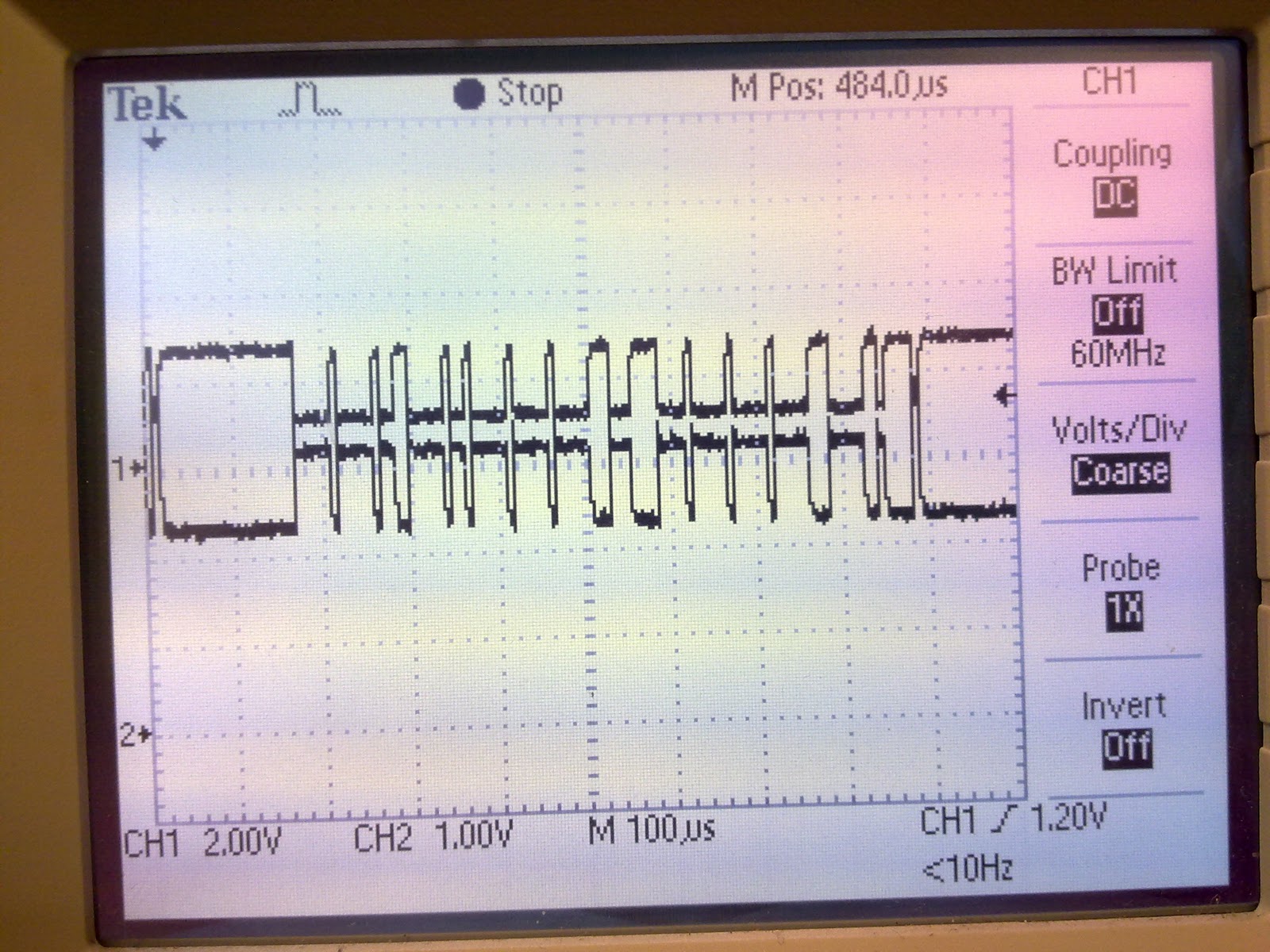
Using the dual trace feature on the oscilloscope capture the full pattern of the H-CAN and L-CAN. Identify which wire is the H-CAN and which is for the L-CAN.
H-CAN: Blue     L-CAN:Yellow     They both connected to the positone

On your capture also identify were the data pattern starts and finishes.
Describe the relationship between the two patterns and their base voltages (what volts when not switched)
The top one patterns is the low can they start off normal and they drop down, the botton one is high can patterns they start off normal and then it jumps up and this test was done without wipers or light on .
For each of the following inputs capture the pattern and identify were it changes in relation to the original pattern: 
Right indicator 
 Rear wiper
 Reverse lights
 Fuel pump
Using the wiring diagram and CAN board Identify the input /output pins, wire colours, Relay or transistor for the right hand indicator and rear wiper:
I choose right hand indicator that starts off with pin 7, it goes to resistor 5 after that it goes to chip 6 -vp18f258/ra4/tocki then it comes out through can-high and can- low straight though channel 1 and then it foes out through con 1 and 2 though 4 and 5 then it goes to the can ship into 7 and 6 goes out through 4 all the way straight to 12 /rxcan/n which is the iC chip then it goes through 5 pass through resistor 32. After that it into the optocaupler the it goes out passes through pull down resistor goes to the transistor then it travels to the connector output 5.
Using the wiring diagram identify both voltage regulators that resemble the one that you built in TTEC4824. Note all the input pins and were the outputs are connected to. 
U1 7805: Input from power supply P1 & P2
              Output is 5V, it goes to P1 (MCLR/VPP) & P20 (VE) on chip VP18F258 P3 (VCC) goes to chip IC4, P16               goes to chip IC3
U2 7805: Input from power supply P1 & P2
              Output is 5V, it goes to P14 (VDD) 
Using the wiring diagram follow one circuit though from the input to the output. Note all the inputs / IC / relays / transistors and describe how the circuit operates
Spare: P10 goes to R7 (14500) then input to P26 on chip VP18F258. Output to P23 & P24, P23 &P24 both goes to chip IC4 and output to P7 & P6, P7 goes to P1, P6 goes to CAN connector P2, P7 & P6 also goes through standared terminal.
Output: P8 goes to RL5b switch when the switch cloesd the RL5a will goes to the transistor U15 then goes to R36 (1K) after input to P1 on chip DIL then P11 comes out to P12 & 13, they input to P1 &P4 on chip IC5 and comes out to P7 & P6 then goes to P4 & P5

2011年12月1日星期四

Blog 3 SAFETY SYSTEMS

SAFETY SYSTEMS

Warrant of Fitness

Work sheet one

Make of vehicle MAZDA  Model FAMILIA Year 1998

Make a list of nine (9) safety components found in your vehicle.

1.ABS system
2.SRS air bags for driver side
3.Hand brake
4.Stop lights
5.Setbelt
6.Child lock
7.Park light 
8.Rear reflectors
9.Warning light for hand brake
SEATBELT INSPECTION and DEFINITIONS.

LTSA regulations:

The regulations for Seatbelts are contained in the Land Transport Rule 32011 – Seatbelts and
Seatbelt Anchorages.

From this ‘Rule’ the inspection criteria for Warrant of Fitness Inspections makes up the VIRM.
This is the inspection manual for all aspects of Vehicle Inspections.

Inspection Criteria:

The Inspection items detailed overleaf are a summury for the requirements of the VIRM.

EXPLANATIONS:

Tongue and Buckle Assembly:

This is the locking mechanism for the securing the seatbelt.
It is vital that the locking mechanism is secure and operating correctly.
Retractor:

The retractor mechanism is often hidden out of site inside the body structure of the vehicle.
The retractor automatically recoils the seatbelt when it is disengaged. It is a mechanical
device and can wear out over time. It is very important that the seatbelt webbing fully retracts
continuously in a smooth operation.

The locking mechanism that prevents occupants from moving forward violently in an accident
or severe braking, is located inside the retractor unit.

Webbing:

Seatbelt webbing is a special polyester weave manufactured and tested to a specific
International Standard for use in motor vehicles.
Damage to the webbing can dramatically reduce the effectiveness of the seatbelt.
Small cuts, frayed edges and holes in the webbing can cause it to tear when put under load.
Badly fade webbing, caused by sunburn and UV exposure, can have it’s strength reduced by
up to 5o%.

Anchorages:

The seatbelt unit must be securely fixed to the vehicle. Loose fittings, rust or insecure
mountings will fail under load.

Accident Dynamics:

In a frontal impact accident at 50 kph, the vehicle occupants’ are propelled forward against
the seatbelt restraint system.
The force applied to the restraint system is equal to 30 times the occupants’ weight. At 70
kph, this force is 60 times the body weight.

The force is applied in an instant, and any defective parts of the seatbelt assembly or
anchorages could result in failure, causing occupants’ to be propelled forward into the  steering wheel, dashboard or through the windscreen.
It is vital that seatbelts are inspected regularly for damage and replaced when found to be
defective.


RESTRAINT SYSTEMS FRONT and REAR

Make MAZDA               Model FAMILIA
Year 2008     Body Type Sanda     Vehicle class MA
Type of Seat Belts (Front) Dwell sensitive   Number R2
                                  (Rear) Dwell sensitive   Number R3

Safety check List

TONGUE and BUCKLE ASSEMBLY
Check the engagement of tongue and buckle          Pass

The tongue and buckle should securely latch          Pass
together with very little free play.

The tongue should eject actively when released     Pass

There should be no visible cracks on the buckle    Pass
and the buckle cover must be intact.

The tongue should have no metal deformation      Pass
webbing marks or visible cracks on metal or
plastic sections.

RETRACTOR
Pull the belt out as far as it will go, then release it. Pass 
The belt should return all the way to the retractor   Pass
Without sticking, gripping or stalling.

The retractor should lock if the webbing is pulled  Pass
out suddenly.

WEBBING

The webbing should be securely attached to its end       Pass
fittings and displaying no stretching or pulled stitching.

The webbing should be flat throughout its entire length Pass

Look for plastic burn marks, frayed stitching and any      Pass
signs of rippling.

Look for fading – exposure to sunlight can reduce the    Pass
strength by up to 50%.

ANCHORAGE

Ensure all anchorages are free from corrosion and are Pass
securely fastened to the vehicle structure.

All mounting points should not show any signs deformation. Pass


Reports:
Everything is good condition nothing wrong .
TONGUE and BUCKLE ASSEMBLY

Check the engagement of tongue and buckle.            Pass

The tongue and buckle should securely latch             Pass
together with very little free play.

The tongue should eject actively when released.       Pass

There should be no visible cracks on the buckle       Pass
and the buckle cover must be intact.

The tongue should have no metal deformation,        Pass
webbing marks or visible cracks on metal or
plastic sections.

RETRACTOR

Pull the belt out as far as it will go, then release it.  Pass

The belt should return all the way to the retractor     Pass
Without sticking, gripping or stalling.

The retractor should lock if the webbing is pulled    Pass
out suddenly.

WEBBING

The webbing should be securely attached to its end      Pass
fittings displaying no stretching or pulled stitching.

The webbing should be flat throughout its entire length Pass

Look for plastic burn marks, frayed stitching and any     Pass
Signs of rippling.

Look for fading – exposure to sunlight can reduce the   Pass
strength by up to 50%.
ANCHORAGE

Ensure all anchorages are free from corrosion and are           Pass
securely fastened to the vehicle structure.                                   

All mounting points should not show any signs deformation. Pass

Reports:
Everything is good working order so far. 


 Supplementary Restraint System

Seat Belt Types: L/D = Lap Diagonal
                               L = Lap
                               D = Diagonal


Air Bags:             
S.R.S. = Supplementary Restraint System
                              A.B = Air Bag
Vehicle one
Vehicle Make: MAZDA                Model : FAMILIA

Year: 1998      Import

Type of Seat Belts: Front (type) L/D      Number: R2
                                   Rear(type)  L/D      Number: R3

AIR BAGS: There just one airbag on the driver side, and looks good

Warrant of Fitness 
WOF Check Sheet.
Make: MAZDA                         Model : FAMILIA
Odometer reading: 234582 
Year: 1998  year first registered in NZ : N/A
WOF exiry date: N/A  Fuel type: petrol 
CHECK AREAS.
 
Area and Rule ID #                           Comments
 
Vehicle Identification.
 
Vin and chassis number: 7A8C10H0703101007
 
Vehicle Exterior :

Structure : its in good condition nothing is wrong with it, the paint is really good .


Lighting:

Headlamps.                        working fine
Front and rear fog lights.  working fine
Cornering lamps .             working fine
Daytime running lamps   working fine
Direction indicator lamps (front)  good working order
Direction indicator lights (rear)     good working order
Forward-facing position lamps    good working order

Rearward-facing position lamps good working order
Stop lamps                                       good working order
High-mounted stop lamps            good working order
Rear registration plate lamp         good working order
Rear reflectors                                 good working order
Reversing lamps                            good working order 
Non-specified lamps                     N/A

Vision:

Windscreen    looks fine no cracks or any damage to it
Other glazing  In good condition
Sun visors       In good condition
Wipers             In good condition
Washers         In good condition
Rear view mirrors In good condition

Entrance and Exit:

Door and hinged panel retention system:

Doors are all fine they close and open good.

Vehicle Interior:

Seats and seat anchorages
Head restraints
Seatbelts and seat belt anchorages      Seatbelts getting old
Airbags
Interior impact
Speedometer
Audible warning device

All these things above are in good condition nothing wrong with it but the seatbelts getting old, that should be change if not the WOF would fail because this is one of the main safety in new Zealand  it saves lives in bad times like accidents .

Brakes:
Components
ABS self check No ABS check light
Service brake performance
Service brake balance
Parking brake performance  
We did the break test using the brake roller and it passed the test. if the brake discs were worn or the pads it would have failed the test its really important to make sure your brakes are all in good working order it doesn't cost much to fix it up and saves you in accidents and when ever you want to brake .

Steering and Suspension:

Steering mechanism:         in good condition
Suspension mechanism: in good condition

Tyres, Wheels and Hubs

Tyre condition in good condition
Tread depth    in good condition
Left front          in good condition
Right front       in good condition
Left rear          in good condition
Right rear       in good condition
Spare wheel security Its                                 
Wheels           left front fail, it's damage
Hubs and axles in good condition
Mudguards         in good condition

Exhaust Raise vehicle for this check

Exhaust System  in good condition

Towing Connections

Towing connection in good condition

Miscellaneous Items

Engine and drive train :    in good condition
Fuel tank and fuel lines : in good condition

Alternative Fuels: N/A

Modified Vehicle: N/A

2011年11月29日星期二

Treaty of Waitangi and Sustainability Worksheet

TTEC4849 Business Practice and Vehicle Safety

Treaty of Waitangi and Sustainability Worksheet


How does sustainability and freedom from pollution pertain to the treaty?

Instructions: Read the Treaty and answer the questions below. This may be used for theory classroom discussion.

HER MAJESTY VICTORIA Queen of the United Kingdom of Great Britain and Ireland regarding with Her Royal Favour the Native Chiefs and Tribes of New Zealand and anxious to protect their just Rights and Property and to secure to them the enjoyment of Peace and Good Order has deemed it necessary in consequence of the great number of Her Majesty's Subjects who have already settled in New Zealand and the rapid extension of Emigration both from Europe and Australia which is still in progress to constitute and appoint a functionary properly authorised to treat with the Aborigines of New Zealand for the recognition of Her Majesty's Sovereign authority over the whole or any part of those islands – Her Majesty therefore being desirous to establish a settled form of Civil Government with a view to avert the evil consequences which must result from the absence of the necessary Laws and Institutions alike to the native population and to Her subjects has been graciously pleased to empower and to authorise me William Hobson a Captain in Her Majesty's Royal Navy Consul and Lieutenant-Governor of such parts of New Zealand as may be or hereafter shall be ceded to her Majesty to invite the confederated and independent Chiefs of New Zealand to concur in the following Articles and Conditions.

Article the first [Article 1]

The Chiefs of the Confederation of the United Tribes of New Zealand and the separate and independent Chiefs who have not become members of the Confederation cede to Her Majesty the Queen of England absolutely and without reservation all the rights and powers of Sovereignty which the said Confederation or Individual Chiefs respectively exercise or possess, or may be supposed to exercise or to possess over their respective Territories as the sole sovereigns thereof.

Article the second [Article 2]

Her Majesty the Queen of England confirms and guarantees to the Chiefs and Tribes of New Zealand and to the respective families and individuals thereof the full exclusive and undisturbed possession of their Lands and Estates Forests Fisheries and other properties which they may collectively or individually possess so long as it is their wish and desire to retain the same in their possession; but the Chiefs of the United Tribes and the individual Chiefs yield to Her Majesty the exclusive right of Preemption over such lands as the proprietors thereof may be disposed to alienate at such prices as may be agreed upon between the respective Proprietors and persons appointed by Her Majesty to treat with them in that behalf.

Article the third [Article 3]

In consideration thereof Her Majesty the Queen of England extends to the Natives of New Zealand Her royal protection and imparts to them all the Rights and Privileges of British Subjects.
(signed) William Hobson, Lieutenant-Governor.
Now therefore We the Chiefs of the Confederation of the United Tribes of New Zealand being assembled in Congress at Victoria in Waitangi and We the Separate and Independent Chiefs of New Zealand claiming authority over the Tribes and Territories which are specified after our respective names, having been made fully to understand the Provisions of the foregoing Treaty, accept and enter into the same in the full spirit and meaning thereof in witness of which we have attached our signatures or marks at the places and the dates respectively specified. Done at Waitangi this Sixth day of February in the year of Our Lord one thousand eight hundred and forty.

                                                                                                                                                 
1.  What part of the Treaty relates to pollution and sustainability? Write the phrase that relates here: (If you can’t find it, reread Article 2)

 Queen of England confirms and guarantees to the Chiefs and Tribes of New Zealand and to the respective families and individuals thereof the full exclusive and undisturbed possession of their Lands and Estates Forests Fisheries and other properties which they may collectively or individually possess so long as it is their wish and desire to retain the same in their possession.


2.  What are ways that modern civilization could pollute the land, the sea, or the air?

  There are many things can pollute land the sea or the air for example oil spill that happened recently in tauranaga that polluted the sea it had really big impact on it killed lots of fishes making the water oily and contaminated for them to swim there as well.
  The land gets contaminated by the excessive farming and deforestation. It causes soil erosion and thus the most fertile layer of the earth gets eroded.
  The air gets polluted by the emissions from the cars and the factories. The residual that comes out from the industries also cause the air quality getting worse.

3.  What New Zealand legislation directs what should happen about pollution? (You may need to do an internet search to find this.) Record your answers here:

The Resource Management Act 1991 is New Zealand’s environmental protection legislation. The Act’s purpose is to promote the sustainable management of natural and physical resources. There are three sections, 15, 17 and 340, that are specifically relevant to your responsibility to prevent pollution.

Section 15 prohibits unauthorised discharges of contaminants to land and water. Put simply, this means that nothing but rainwater can be discharged onto the ground, into stormwater drains or into streams, lakes or the sea without authorisation from the Regional Council. It is illegal to cause pollution and substantial penalties can be imposed, including fines up to $200,000 and up to two years imprisonment. See Section 15 of The Resource Management Act 1991 on www.legislation.govt.nz

Section 17 makes individuals responsible for ensuring that their activities do not result in pollution. Everyone must take responsibility for his or her actions. If you are the director of a company, you are also responsible for ensuring that all of your staff and contractors are aware of this responsibility. See Section 17 of The Resource Management Act 1991 on www.legislation.govt.nz

Section 340 makes you responsible for works carried out on your behalf (i.e. by your employees or people you have contracted or subcontracted to) and means you can be held liable for any unauthorised discharges to ground or the stormwater system as a result of those activities. See Section 340 of The Resource Management Act 1991 on www.legislation.govt.nz


Air pollution monitoring is done by a number of organisations in New Zealand, including the Institute of Environmental Science and Research (ESR), the National Institute for Water and Atmosphere (NIWA), Regional Councils and industry. 

2011年11月27日星期日

TTEC4849 Business Practice & Vehicle Safety

Vehicle Safety Inspection Sheet

Instruction:  Use this form to do a safety check on a vehicle and record whether systems meet compliance with New Zealand Vehicle Safety Regulations. Information on Regulations can be found at http://www.nzta.govt.nz/resources/virm-in-service-certification/virm-in-service-certification.html#intro. Use a flat floor shop area and a vehicle to perform the inspection. ( keep standard safety practices in mind. ) The Brake Test to be performed on the Rolling Road Dyno in 108-1065 under the guidance of  your Lecturer. Analyze your findings at the end to make recommendations for the vehicle.

Student Name Leo           Contac No 021908162

Vehicle: Make MAZDA   Model FAMILIA  Year 1998

VIN: SSBELTSOK01007  Fule type: Petrol

External Inspection:

Compliant?          Item:                                                    Comments:
Yes                     Direction Ind. Lamps Front                  Good
Yes                     Forward Position Lamps                      Good
Yes                     Front Fog Lamps                                 Good
Yes                     Direction Ind. Lamps Rear                   Good
Yes                     Rearward Position Lamps                    Good
Yes                     Stop Lamps                                         Good
Yes                     Hig-mounted Stop Lamps                    Good
Yes                     Registration Plate Lamps                      Good
Yes                     Rear Reflectors                                    Good
Yes                     Other Lamps                                       Good
Yes                     Windscreen                                         Good
Yes                     Other Glazing                                      Good
Yes                     Doors and Hinged Panels                    Good
Yes                     Mudguards                                          Good
Yes                     External Projections                             Good
Yes                     Structure/Corrosion                             Good
Yes                     Dimensions                                          Good

Internal Inspection:

Compliance?       Item:                                               Comments:
No                      Wipers/Operation                           Non operation
Yes                     Rear View Mirrors                         Good
Yes                     Sun Visors                                     Good
No                      Seatbelts                                        Getting old
Yes                     Seatbelt Anchorages                      Good
Yes                     Seatbelt & Seat Anchorages          Good
Yes                     Head Restraints                             Good
No                      Interior Impact                               N/A
Yes                     Air Bag Self Check                        Good
No                      ABS Self Check                            No ABS Check Light
Yes                     Audible Warning Device                Good
No                      Spare Wheel Security                    N/A
No                      Space Saver Warning Label           N/A

Chassis Underbody:

Compliance?      Item:                                              Comments:
Yes                    Wheels, Hubs & Axels                   Good
Yes                    Steering Mechanism                       Good
No                     Suspension Mechanism                  Bent Suspension Link
Yes                    Fuel Tank & Fuel Lines                  Good
Yes                    Cable Linkage                               Good
Yes                    Brake Controls                              Good
Yes                    Lines & Hoses                               Good
Yes                    Exhaust System                             Good
Yes                    Tire Condition                               Good
Yes                    Tire Tread Depth                           Good
                                                                                          LF 4mm     RF 2.9mm     LR 3mm     RR 4.1mm
Yes                    Towing Connections                      Good
Yes                    Towing Safety Chain( s )                Good
Yes                    Structure/Corrosion                       Good

Road Brake Test:

Compliance?      Item:                                             Comments:
Yes                    Service Brake Readings                Pass
                                 Front 7%     Rear 8% or     LF 2.83     RF 3.7     LR 1.00     RR 0.92
Yes                   Service Brake Performance           Good
Yes                   Service Brake Balance                  Good
Yes                   Parking Brake Readings                Good
                                                                             16% or     LH 1.23     RH 1.03 
Yes                   Parking Brake Performance          Good
Yes                   Speedometer                                Good

Under Bonnet:

Compliance?     Item:                                            Comments:
No                    A/F System in Working Order     N/A
No                    A/F System Cert. Current            N/A
No                    A/F System Safe                         N/A
No                    Modified Vehicle                         N/A
No                    Chassis VIN Number                  N/A
No                    Structure/Corrosion                     N/A
No                    Engine & Drive Train                   N/A
No                    Fuel System                                 N/A